
Bad Breath (Halitosis): What Actually Causes It and How to Fix It

Most people assume bad breath is a hygiene problem. Brush more, floss more, use more mouthwash, and it should go away.
For a lot of people, it does not. They brush twice a day, scrape their tongue, carry mints, and still catch someone shifting back slightly during a conversation. If that sounds familiar, the issue is usually not how often you brush. It is what is causing the smell in the first place, and whether brushing can reach it at all.
This article explains what actually causes bad breath, what you can fix at home, and when it is worth seeing a dentist.
This article is for general information only. Please consult a registered dentist or doctor for an assessment specific to your health.
Why Does My Breath Still Smell If I Brush Twice a Day?
Bad breath, known medically as halitosis, is caused mainly by bacteria breaking down food particles and proteins in the mouth. As they do this, they release volatile sulphur compounds — the same family of compounds responsible for the smell of rotten eggs.
Brushing removes bacteria from the surfaces of your teeth. The problem is that those surfaces make up only about a quarter of the total surface area inside your mouth. The rest is your tongue, your gums, the roof of your mouth and the spaces between your teeth. A toothbrush does not reach most of it.
So if you have persistent bad breath despite good brushing habits, it usually means the bacteria are living somewhere your toothbrush is not going.
What Actually Causes Bad Breath?
Bacteria on the tongue
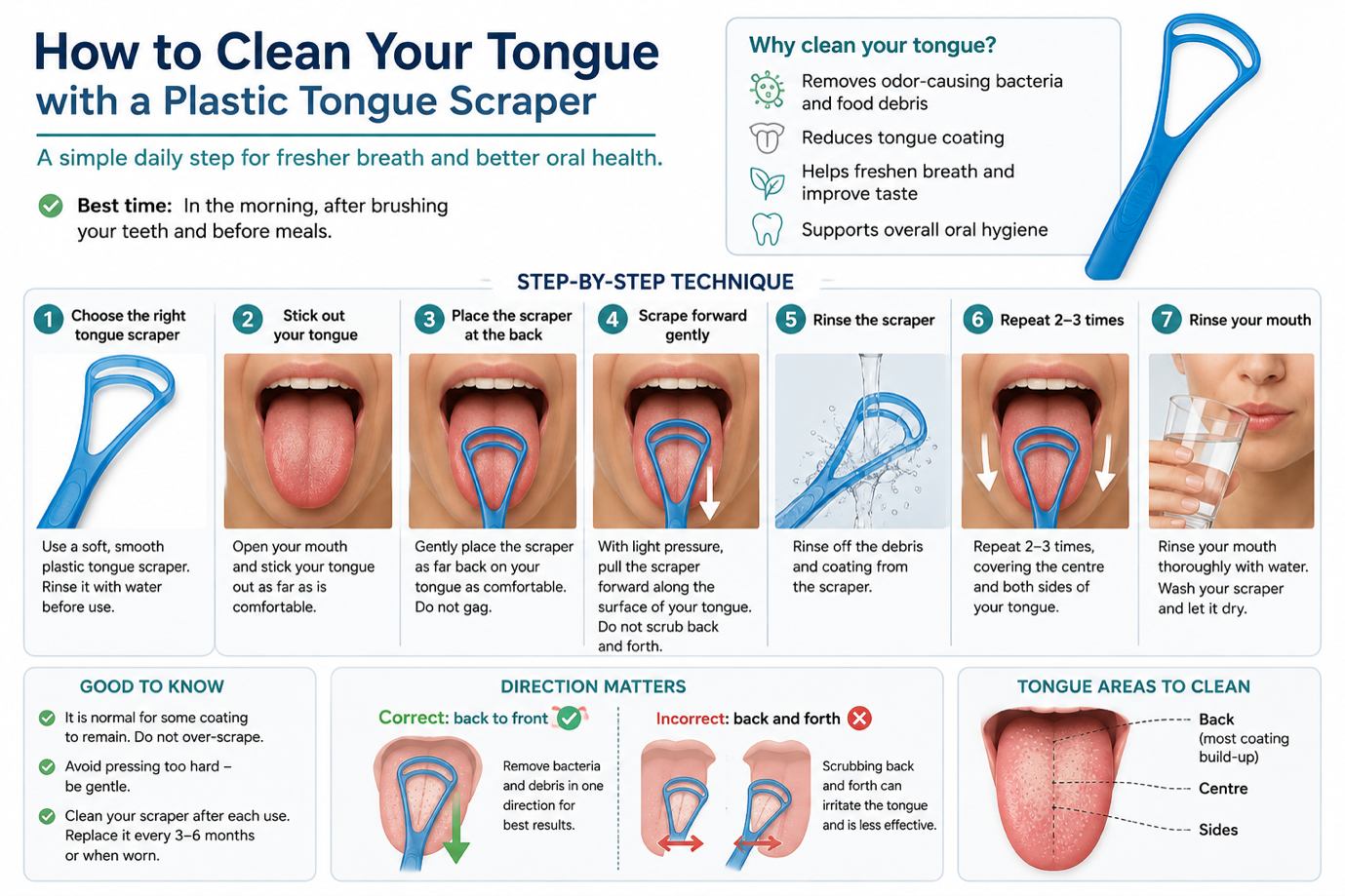
This is the single most common cause. The upper surface of the tongue is covered in tiny raised structures, and the grooves between them trap food debris, dead cells and bacteria. Over time this forms a visible white or yellowish coating, usually thickest toward the back of the tongue.
Because the back of the tongue is the area people clean least, it is often the main source of the smell.
Gum disease
If your gums bleed when you brush, look red or swollen, or have started to pull away from your teeth, bad breath may be a symptom rather than a separate problem.
In gum disease, bacteria collect in the space between the gum and the tooth. As the condition progresses, that space deepens into a pocket that cannot be cleaned by brushing or flossing at all. The bacteria inside it produce a persistent smell that no amount of home care will remove, because home care physically cannot reach the pocket.
This is worth taking seriously. Around nine in ten Singaporean adults have some form of gum disease, and in its early stages it is often painless. Bad breath is sometimes the first thing a person notices.
Read more: 5 Early Warning Signs of Gum Disease You Shouldn't Ignore
Dry mouth
Saliva washes away food particles and keeps bacterial growth in check. When saliva flow drops, bacteria multiply and odour increases.
This is why almost everyone has morning breath — saliva production falls while you sleep. But some people have a persistently dry mouth throughout the day. Common reasons include:
Certain medications, including some for blood pressure, allergies, depression and anxiety
Breathing through the mouth, especially while sleeping or if the nose is blocked
Not drinking enough water across the day
Some medical conditions affecting the salivary glands
Trapped food, decay and failing dental work
A cavity, a cracked filling, an ill-fitting crown or a denture that is not cleaned properly all create spaces where food and bacteria collect and stay. Food trapped between two teeth for a day or two produces a very noticeable smell.
If your bad breath seems to come from one specific area of your mouth, this is often the reason.
Read more: Tooth Decay
Food, drink and smoking
Garlic, onions, certain spices, coffee and alcohol all contribute, but they work differently from the causes above. Their compounds are absorbed into the bloodstream and released through the lungs, which means brushing will not remove the smell — it fades on its own over several hours.
Smoking and vaping affect breath in two ways. They leave their own residual smell, and they reduce saliva flow and blood supply to the gums, which raises the risk of gum disease and the odour that comes with it.
Less common causes
Sometimes the source is not the mouth at all:
Tonsil stones — small, hard, pale deposits that form in the tonsils and have a strong smell
Sinus infections or post-nasal drip — mucus draining down the back of the throat feeds bacteria
Acid reflux — stomach contents moving back up the oesophagus
Certain medical conditions, including uncontrolled diabetes, and some liver or kidney conditions, which can produce a distinctive breath odour
These are far less common than oral causes. But if a dentist examines your mouth and finds nothing that would explain the smell, this is the direction to investigate with a doctor.
How Do I Know If I Actually Have Bad Breath?
You cannot reliably smell your own breath. The nerves responsible for smell adapt quickly to constant odours, so your own breath becomes background to you.
Two rough self-checks:
The floss test. Floss between your back teeth and smell the floss. This tells you what is happening in the areas you cannot see.
Ask someone you trust. Awkward, but far more accurate than any home test.
If you find yourself constantly checking, using mints throughout the day, or avoiding close conversation, that is reason enough to get it looked at properly.
What Can You Do At Home?
These help, and are worth doing regardless of the cause:
Clean your tongue daily. Use a tongue scraper or the back of your toothbrush, working from as far back as you can comfortably reach toward the front. Rinse and repeat a few times.
Clean between your teeth every day. Floss or interdental brushes reach the surfaces where odour-causing bacteria concentrate. Brushing alone leaves roughly a third of each tooth uncleaned.
Drink water regularly. Particularly if you are on medication that dries the mouth, or if you spend the day in air-conditioning.
Chew sugar-free gum after meals if your mouth tends to feel dry. It stimulates saliva.
Clean dentures and retainers properly, following the instructions you were given. They collect bacteria in the same way teeth do.
Does mouthwash help?
It helps temporarily. Most mouthwashes mask odour rather than remove its source, and some alcohol-based rinses can dry the mouth, which may make things worse over the longer term.
Mouthwash is a reasonable addition to brushing, tongue cleaning and flossing. It is not a substitute for any of them, and if you find you need it several times a day to feel comfortable, that is a sign the underlying cause has not been dealt with.
When Should You See a Dentist?
Book an appointment if:
Bad breath persists for more than a few weeks despite good oral hygiene
Your gums bleed when brushing or flossing, or look red, swollen or receded
You have a bad taste in your mouth that does not go away
One specific tooth or area seems to be the source
You have not had a scaling and polishing in over a year
What Will a Dentist Do About It?
The first step is finding the source. A dentist will examine your gums, check the depth of any gum pockets, look for decay, cracked fillings or failing dental work, and assess your tongue coating and saliva flow.
Treatment then depends on what is found. It may involve scaling and polishing to remove hardened plaque, deeper cleaning below the gum line if gum disease is present, repairing or replacing dental work that traps food, or advice on managing dry mouth. Where nothing in the mouth accounts for the smell, your dentist can advise you to see a doctor to look at other possible causes.
In most cases the cause turns out to be straightforward, and treatable.
Read more: Gum Disease in Singapore · How Often Do You Need To See A Dentist
Is Treatment Covered Under CHAS?
Scaling and polishing is covered under CHAS for eligible patients, which makes routine cleaning one of the most affordable ways to keep breath and gum health in check. Treatment for more advanced gum disease may have components that are claimable , your dentist can advise on what applies in your case.
Read more: CHAS and Dental Care in Singapore
Speak to a Dentist
If bad breath has been bothering you and home care has not resolved it, book a consultation with one of our dentists. It is a common concern, and it is one we assess routinely.
Book an appointment now!
All clinical information in this article is based on publicly available research and health authority guidance. For the most current clinical recommendations, refer to the Ministry of Health Singapore at moh.gov.sg and the National Dental Centre Singapore at ndcs.com.sg


